
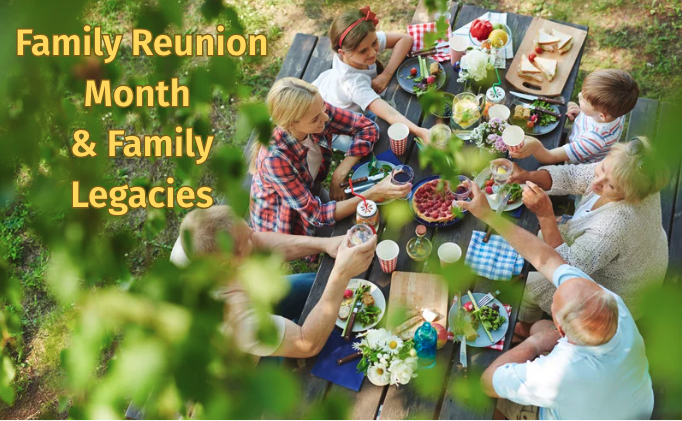

One side of my mother’s family holds a family reunion every couple of years on the 4th of July. It allows those who live away to come in and for those of us who live close geographically, but who lose touch in our day to day lives to gather, reminisce, talk about the weather, kids and grandkids. This wasn’t our normal reunion year, but there are only two siblings remaining from my grandmother’s family and neither are in good health, so we moved it up a year.
I wasn’t able to attend due to work obligations and an anxious pet that couldn’t be left alone for fireworks, and I’m sad about it, because it may have been the last time to spend time with those great aunts and uncles. My grandmother died two years ago, and I already feel that we’ve lost so many of our family stories with her.
Going through things at my grandma’s place, I learned so much about her past she didn’t tell us. I remember having a conversation at my paternal grandmother’s visitation with my cousin about our grandmother spending a short time being raised by nuns when she was a toddler after her mother’s death. My cousin had no idea.
What I’ve learned from these instances and in my work as a departure EOL doula is that these “ordinary” family gatherings, the barbecues and reunions or fall weenie roasts where we joke and swap the same stories year after year – the time your uncle got caught playing poker for cigarettes, the year my grandma got me an entire pig’s head for Christmas as payback for chocolate mice – are not ordinary at all. They are priceless. We aren’t just sharing a meal, we’re passing along pieces of ourselves and those we love who are no longer with us.
Our Stories Are Our Inheritance
Most of us think about inheritance as financial or physical assets – the retirement accounts, the jewelry, the house or cars. Many families too often fracture and rupture over the distribution of these things, too, but now that my mother and her mother and my paternal grandparents are no longer here, I know what I miss most are those stories. I went through boxes of pictures and sometimes no one knew who else was in them or what the picture commemorated. We have lost our historians.
The stories that made us laugh, or cry. The stories that told us how my grandmother survived after she became a young widow with four children. The story of my biological great-grandmother Pearl who died too young. The story about my paternal grandfather taking a train across the country on leave from Japan in WWII, just to see my grandmother for a few hours to then take the train back.
Our stories inform our values. These stories tell us what it means to be family. These stories are our legacy carrying the lessons and memories of our ancestors into our lives today and into the lives or our descendants in the future. It keeps them alive and brings us comfort and blessings long after the china, jewelry and property has been divided.

Ask the Questions While You Still Can
We have short attention spans. We are all guilty of distraction. Getting together for a quick meal, but our to-do list is niggling us in the back of our mind, and we aren’t really paying attention. We are checking emails or scrolling social media. The Christmas get-together that is too quick because of all the obligatory visits we have to make on the same day.
Summer gatherings are more relaxed. You find the group that has the best spot in the shade or access to the fan and you hang out there together with only the distraction of mosquitos or how to balance your plate and glass on the ancient folding chair. It lends itself to conversations – lazy and meandering ones. It’s the perfect time to ask questions, and really listen to what the stories reveal.
In my work, if there is time, I like to ask the people I serve questions that help me get to know them, but that also help me preserve their legacy for their family, friends or posterity. I cannot count the times that my asking one question has started heartfelt conversations between loved ones and uncovered, recovered or created connections that have brought healing, comfort and peace to loved ones during and after death.
Through the years, I’ve gathered several conversation-starting questions that help encourage people to tell their stories. None of them have to be asked and recorded like a formal interview. None of this is about a perfect record. Just ask the question, let the conversation start and let others join in where they want. Jot down quick notes in your note app on your phone. Use your voice recording app there, but don’t let the note taking or technology or striving to be perfect distract you from the opportunity at hand – listen to know, understand and connect.
Here are some suggestions to get you started.
- What is your earliest memory?
- When did you know you were in love?
- What was an ordinary day like when you were growing up? Newly married? A new parent?
- What is the secret for living well? How would you describe a life well-lived?
- What is the wisest piece of advice you ever received?
- What is your favorite/greatest memory?
Conversations NOT Interviews
Did you have to learn dates and names in your history classes to pass tests? Do you remember those dates and names today?
Can you remember the dates, facts, equations or information you learned from singing the songs from School House Rocks?
Can you list of names, dates and the personal history of Washington, Burr and Hamilton because you’ve heard the soundtrack a million times and have seen the musical a few times, too?
Just me?
Facts aren’t stories. We don’t retain facts. Stories don’t just tell us facts, they give us depth. They provide context and connections.
Maybe you know you’re grandfather was a member of the armed services. Do you know what he was most afraid of? Do you know who his greatest mentor was? Do you know what he was most excited about when he got to come home after serving?
Facts are important and informative.
Stories are valuable and transformative.

Don’t Wait
Life is short.
The uncle who tells the same story every Christmas? He maybe won’t be able to recall it next Christmas.
The aunt who remembers every birthdate and anniversary? She may become incapacitated and not be able to attend your family gathering.
The mother who had every trick and secret ingredient for perfectly recreating the family recipes? She may die without writing them all down.
I may not get the chance to laugh at my great- Uncle Jimmy’s dad jokes by the time the next reunion comes around.
Life is finite. Those jokes, stories, and advice are legacy. Collect and cherish them.
In closing, I really want to encourage you to pose one of the questions above at your next family summer event. Ask. Then listen.
The greatest gift you can give is listening and preserving a legacy. And you’ll be blessed with the gift of a story that only they could tell.
OFFER
I have a journal and workbook of legacy questions you can use to start these conversations. It provides a place for you to jot down the answers and stories you learn. Or you can use the questions to begin your own legacy work. Your story matters, too. Don’t wait to start telling it.
Reach out to [email protected] for your copy.